Which High-Risk Zones in New York City Require Executive Protection Teams?


New York City is one of the most dynamic and high-pressure environments in the world for corporate leaders, investors, and public figures. With dense crowds, unpredictable events, and a complex urban landscape, the demand for executive protection in New York City has grown significantly among business leaders who refuse to leave safety to chance. Whether you are running a firm in Midtown or attending a board meeting in the Financial District, understanding where the real threats exist is the first step to building a smart protection strategy. Private security for business leaders in NYC is no longer optional; it is a calculated business decision.
Why is Location Intelligence the Foundation of Executive Security?
Professional protection teams do not just follow people. They study environments. High-risk zones are identified by analysing threat density, crowd behaviour, protest activity, surveillance gaps, and historical incident data. In New York City, certain areas demand more attention than others, and knowing which zones require it allows security guard services to position the right personnel at the right time.
An effective protection plan starts with route analysis, venue assessments, and real-time intelligence, not just physical presence.
Which NYC Zones Carry the Highest Risk for Business Leaders?
Midtown Manhattan The Corporate Threat Corridor
The stretch from 34th Street to 59th Street houses more Fortune 500 headquarters than almost anywhere in the country. This concentration of decision-makers creates a predictable pattern of movement, and predictable patterns attract risk. Executives moving between meetings, hotels, and parking facilities in Midtown are especially vulnerable during morning and evening commutes.
The Financial District Wall Street's Hidden Vulnerabilities
The Financial District may seem locked down, but the narrow streets, crowded transit hubs, and protest-prone areas near Wall Street and Zuccotti Park create real exposure. Banking and investment professionals regularly move through spaces where crowd surges and targeted demonstrations can shift from manageable to dangerous within minutes. Executive protection New York City teams operating in this zone must excel at crowd navigation and rapid egress planning.
Times Square Controlled Chaos at Scale
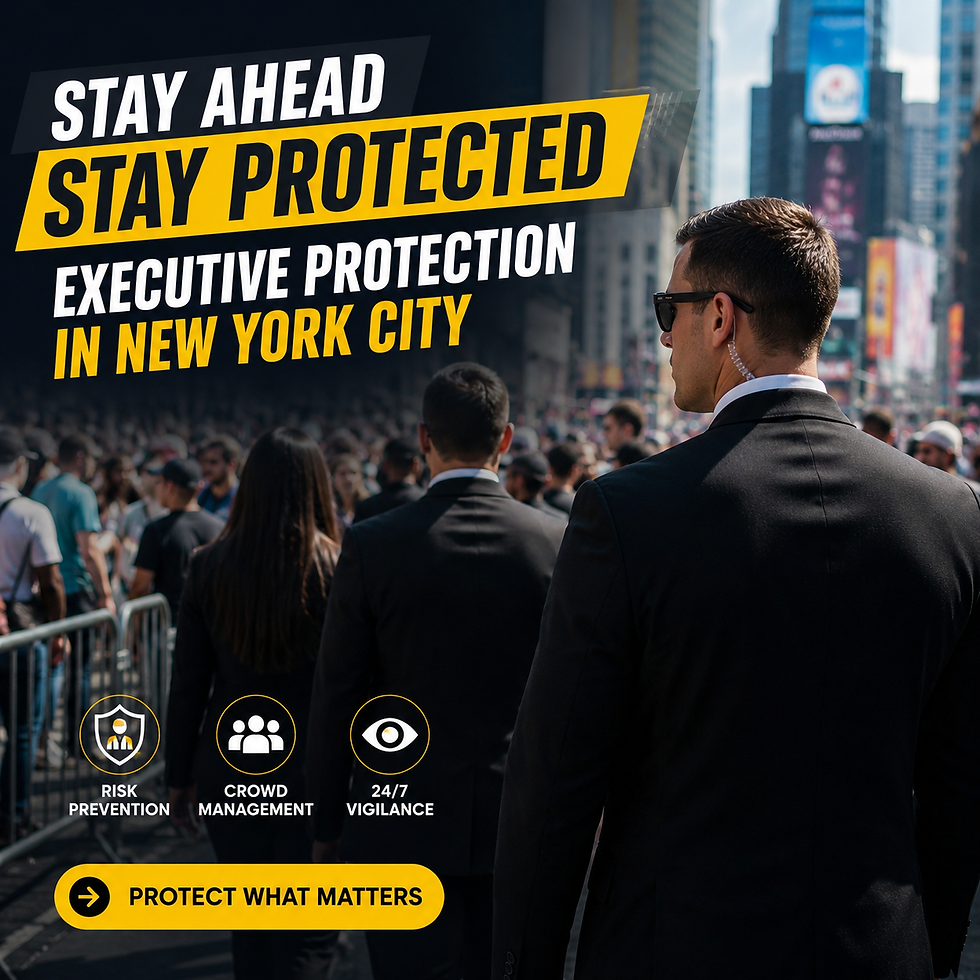
Times Square sees over 300,000 people daily, making it one of the most surveillance-saturated and simultaneously most chaotic zones in the city. The volume of foot traffic, the presence of strangers, and the limited escape routes make it a challenging environment for security guards assigned to protect a visible executive or public figure. Threats here are rarely targeted attacks; they are more often opportunistic, and that unpredictability is exactly what makes Times Square dangerous.
Upper East Side Residential Exposure
Many high-net-worth individuals and senior executives live in the Upper East Side. Unlike commercial zones, residential areas pose a different threat profile: stalkers, paparazzi, disgruntled individuals, and the potential for physical proximity to the principal's personal life. The protection details here focus on home security assessments, vehicle approach protocols, and maintaining low visibility while remaining operationally sharp.
Transit Hubs JFK, LaGuardia, and Penn Station
Airports and train stations are among the most vulnerable points in any executive's daily travel. Crowded terminals, fixed entry and exit points, long wait times, and limited control over the environment make these areas high-priority for protection planning. Private security for business leaders in NYC almost always includes transit coverage, particularly for clients who travel internationally or maintain heavy meeting schedules.
Brooklyn and DUMBO The Emerging Executive Corridor
As the tech and creative industry expands in Brooklyn, so does the presence of high-value targets. DUMBO, Williamsburg, and areas near the Brooklyn Bridge have seen an increase in executive movement. These neighbourhoods carry fewer police resources per square foot than Midtown and present surveillance blind spots that professional protection teams must actively manage.
What Do Executive Protection Teams Actually Do in These Zones?
Understanding the zones is one thing, knowing what trained professionals do inside them is another. Here is what a serious protection operation looks like on the ground:
Advance work and site surveys are conducted before the principal arrives.
Threat and vulnerability assessments for each location.
Secure transportation coordination and route redundancy.
Real-time monitoring of protest activity, civil unrest, or crowd anomalies.
Counter-surveillance measures to detect early-stage threat behaviour.
Medical response capability integrated into the protection detail.
24/7 command availability for rapidly changing itineraries.
These are not just security guards standing at a door. These are trained professionals operating with military and law-enforcement discipline in the private sector.
Secure Your Success—Key Traits to Look for Before You Hire
Not all security guard services are built for executive-level work. When evaluating a team for high-risk urban environments like New York City, business leaders should ask the right questions:
Does the team have verifiable experience in close protection and urban threat environments?
Are personnel licensed through the New York State Division of Licensing Services?
Can the team demonstrate advanced work capabilities, not just physical presence?
Is there a command structure with clear communication protocols?
Does the firm provide intelligence briefings, not just personnel?
Experience in New York City specifically matters. This city has a pace, a complexity, and a political climate that requires local knowledge, not just general security training.


Comments