The Role of Unarmed Guards in Keeping Manhattan’s Museum District Safe for Visitors

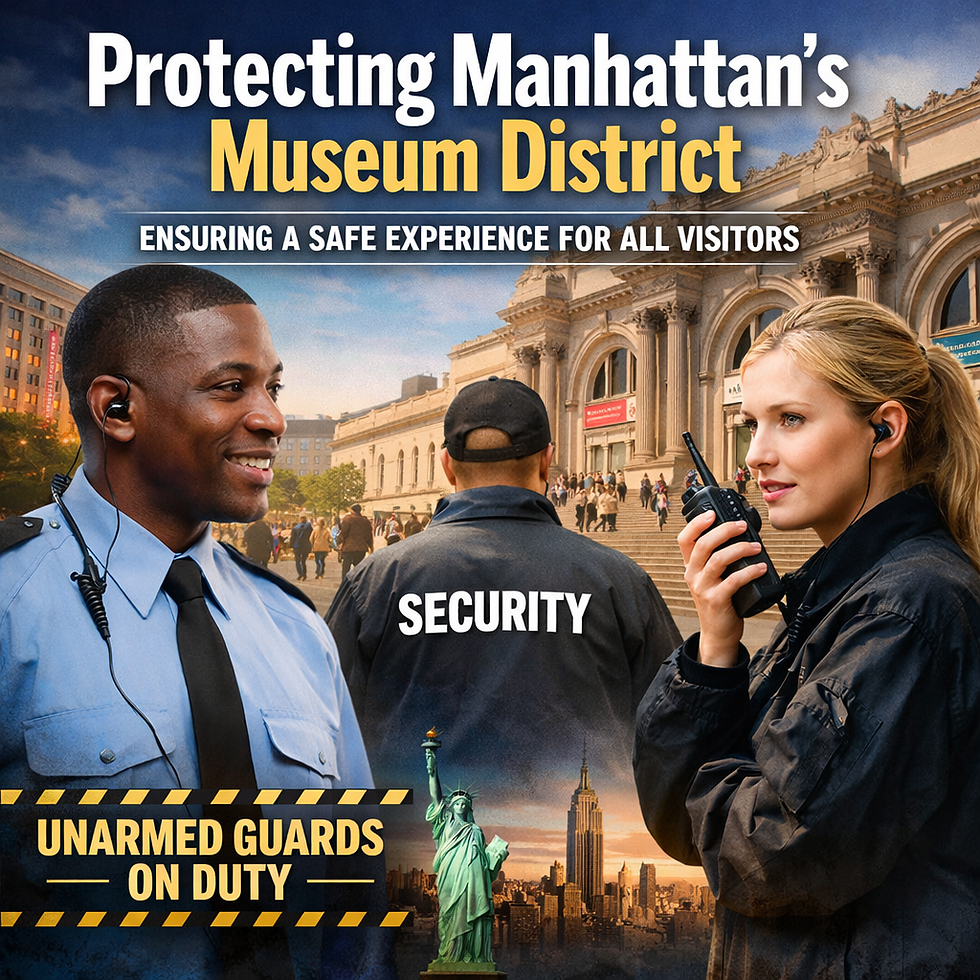
The Museum District of Manhattan lies on one of the most visited roads of New York, receiving thousands of visitors annually from both local and foreign places. There are world-renowned museums that attract hordes of visitors, contain valuable treasures, and work in an open atmosphere where it is as important to create a friendly ambiance as it is to manage risks. Security professionals always grapple with the same fundamental dilemma: how can they ensure safety without making it appear threatening? It all comes down to having professional security guards who exude power and authority but do not need a gun to achieve it.
The Map above highlights major institutions in the district where professional security services operate daily:
What Makes Museum Environments Different from Other Security Settings?
Museums aren’t offices or storage facilities; they run as cultural establishments whose central mission includes that of ensuring an enjoyable visitor experience. From families to schoolchildren on class trips, from seniors to international tourists, the same door is used by everyone. The sight of heavily armed guards in such an environment can cause undue stress, particularly to young visitors and those not acquainted with American security measures.
That distinction matters deeply when hiring. Museum directors and operations managers are increasingly prioritizing non-armed professionals who are trained in:
Crowd flow management and entry control.
De-escalation and verbal conflict resolution.
Emergency evacuation coordination.
Exhibit access monitoring and visitor compliance.
Incident documentation and reporting.
These responsibilities require soft skills, cultural awareness, and communication ability far more than physical force.
Why Do Cultural Institutions in New York Prefer Non-Armed Personnel?
It is also very close to what a major museum does when faced with the task of having to fulfill its dual responsibilities of protecting the museum’s collection and protecting its visitors. Guns pose an increased risk in crowded museum galleries, a risk that many museums would not want to take on board. Other than liability, there is a simple matter of operations. Most incidents that occur in a museum setting rarely involve violence. Most often, it is a case of a child who got lost, a sick person, or some kind of argument at the entrance.
Professional unarmed guards for Manhattan deployments are now standard across institutions along Fifth Avenue and Central Park West. The Museum Mile corridor, which runs from roughly 82nd Street to 105th Street on the Upper East Side, hosts an extraordinary concentration of cultural assets within a very small geographic footprint, making coordinated, visible security coverage both practical and essential. What Responsibilities Do Non-Armed Security Officers Typically Handle?
Inside a museum setting, the daily duties of a security officer cover far more ground than most people expect:
Access control at entrances and galleries, verifying tickets, managing bag checks, and ensuring restricted areas remain off-limits
Patron assistance answering directional questions, assisting individuals with mobility needs, and supporting staff during high-traffic events.
Surveillance monitoring, patrolling exhibition halls, and maintaining visual awareness of visitor behavior near high-value pieces.
Event security manages flow at galas, private previews, and after-hours programs where alcohol is served, and large groups gather
Emergency response support working alongside FDNY and NYPD protocols during evacuations or medical events
Each of these tasks demands professionalism, consistency, and the ability to remain calm in a dynamic public environment.
How Does Unarmed Security Protect Both Visitors and Collections?
There is a direct relationship between visible, professional security and the overall visitor experience. When someone spots a courteous, uniformed officer near a gallery entrance, that presence alone discourages opportunistic theft or disruptive behavior. This concept, known broadly as deterrence-based physical security, is well-documented in facility protection practices across the cultural sector.
For collections specifically, the risk profile is quite different from a retail store or corporate campus. A museum's most valuable assets cannot simply be replaced. Preventive protocols, including regular patrol routes, strict access limitations, and diligent monitoring of high-traffic areas, are the primary tools. Non-armed personnel are exceptionally well-suited to this kind of careful, consistent, observation-driven role.
What Should Museum Administrators Look for When Hiring Security Providers?
When vetting a security services company for a cultural institution in Manhattan, several factors carry particular weight:
Training credentials officers should hold current New York State security licenses and demonstrate ongoing training in de-escalation and crowd management.
Museum or cultural institution experience, prior work in similar environments, matters significantly in terms of judgment and visitor interaction skills.
Uniform professionalism and communication staff serve as visible representatives of the institution and must present accordingly.
Supervisory support structure, a reliable provider deploys site supervisors, maintains scheduling redundancy, and offers direct management contacts for real-time communication.
Familiarity with local emergency protocols, understanding how NYPD and FDNY coordinate with building security teams in Midtown and the Upper East Side, is a practical advantage.
Are Non-Armed Security Officers Effective Against Serious Threats?
One of the most frequently asked questions when reviewing security coverage is whether it requires armed officers. The answer is yes, but only under the proper circumstances. Unlike banks or courthouses, which are considered high-threat areas, museums are not considered high-risk venues where physical violence could happen. Instead, they face threats of vandalism and theft of valuable artifacts, the handling of large crowds, and overall situational awareness.
In the event of emergencies, specially trained security guards who do not have firearms should know how to implement an escalation strategy, including contacting the authorities, evacuating the public, and securing the premises. This is not supposed to take the place of police intervention. Rather, it is part of a larger, well-coordinated plan.
Local Context: Security Along the Upper East Side and Beyond
The Museum District comprises an area that also contains residential blocks, educational facilities, and upscale commercial establishments such as Madison Avenue. Security services within the region need to be conducted in accordance with the community characteristics of the Upper East Side, while dealing with the magnitude of establishments that cater to tourists worldwide. A security company with awareness of the geography, ranging from pedestrians on weekend afternoons to events planned around the fundraising periods of the museums, provides better security compared to companies that lack geographical expertise.
Security needs at Central Park West are distinct because of proximity to the park itself, bus lines, and one of the most heavily populated thoroughfares in the city. The requirement for coverage at establishments located here varies greatly from what is required for those found on Fifth Avenue, and needs employees who can adjust according to varying levels of pedestrian movement during different periods of the day.
For your institution that seeks to elevate its standards of visitor security without diminishing the inviting atmosphere that distinguishes good museums, get in touch with a professional security company with experience in cultural and public security in Manhattan.



Comments